Hello, Sobat Kelana! The Kelana Team is back with an exciting and interesting story from one of our Sobat Kelana named Rasen, who participated in the Sleman Temple Run 2025 event. Let’s hear the story together!
Currently, sport tourism is becoming increasingly popular among the public, with a wide variety of activities available to meet the needs and demands of tourists. The World Tourism Organization (UNWTO) defines sport tourism as a type of tourism that provides travel experiences involving tourists as either observers or active participants in sporting events that are generally competitive in nature.
Sudarningsih, Head of the Sleman Tourism Office, revealed that the Sleman Regency Government, through the Tourism Office (Dinpar), has designated Sleman as a sport tourism destination (Novitasari, 2023). The Sleman Temple Run (STR) event is a sports tourism product innovation introduced by the Sleman Regency Tourism Office (Dinpar) since 2015. This event is the only regional activity in the world that involves running around and entering temple complexes as cultural heritage sites located in Sleman Regency.
10 August 2025 was a memorable and meaningful day for Rasen as he had the opportunity to participate in the Sleman Temple Run 2025 event in the 7km category. He admitted that this event was his first experience participating in a running event, as well as his first experience running on a trail. The Sleman Temple Run is an annual running event that is quite prestigious, with a concept that invites participants to run through temples located in the Sleman area. This year marks the 10th time the event has been held. Rasen revealed that the Sleman Temple Run 2025 offered a trail route that passed through the hills in the temple area, such as Banyunibo Temple, Ijo Temple, Barong Temple, Arca Gupala Temple, Miri Temple, and several archaeological sites and natural tourist destinations.

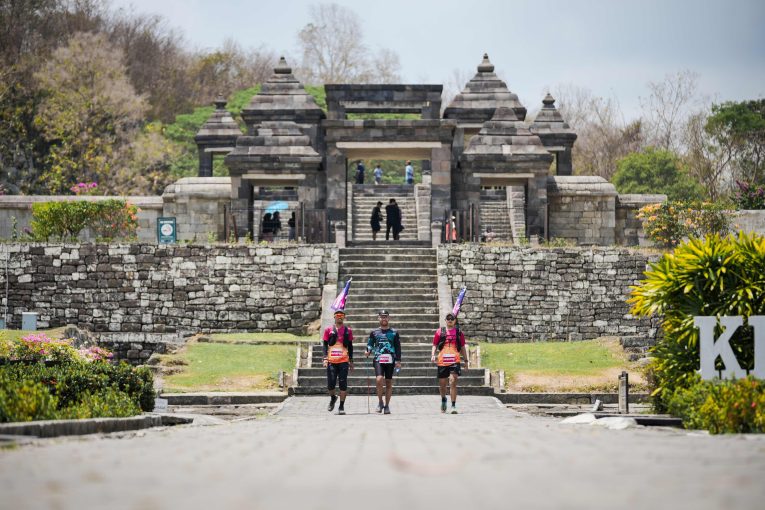
Photo: Rasen being welcomed upon arrival at Ratu Boko
According to him, the moment at Ratu Boko was the most memorable because the runners were greeted by children lined up on both sides of the track, waving small red and white flags. In addition, the cheers from the spectators were loud and the photographers were busy taking pictures of the runners as they passed by. Performances of traditional music and dance also welcomed the runners. After running for 44 minutes and 36 seconds, Rasen arrived at Banyunibo Temple, which was the finish line of the 2025 Sleman Temple Run. He was the 10th finisher out of 390 runners. The names of the participants, their bib numbers, and their times could be seen on the bib number check displayed on a large screen upon arrival at the finish line. Immediately after crossing the finish line, the participants could capture the moment with Banyunibo Temple as the backdrop.
Facilities such as ice baths, medical check-ups, and food were provided by the organizers upon reaching the finish line. Food and beverages were served on plates and in glass cups to minimize waste generated from the event.
Despite the positive experiences of participants, this activity also had some negative impacts that need to be addressed in terms of management. Rasen revealed that some participants ran on the temple stones despite warning signs asking them not to run in the temple area, as this could erode and even damage the stones, which are a cultural heritage site.
The issue of sustainability in sport tourism is also closely related to the conservation of cultural heritage sites. In July 2025, UNESCO warned that climate change and overtourism could accelerate the destruction of world heritage sites. In the context of the large number of participants in the Sleman Temple Run, UNESCO’s warning is important to note so that the temples that are part of the running event route are preserved. This situation also highlights the importance of managing the number of tourists and activities in heritage areas so as not to cause cultural or physical degradation of the sites. In line with this, a study also confirms that dense crowds of tourists make heritage sites more vulnerable to damage (Nation Thailand, 2025; Taylor & Francis Online, 2024).

Photo: Rasen managed to finish 10th with a time of 44 minutes and 36 seconds.
The phenomenon of sports tourism is not only growing at the local level, such as the Sleman Temple Run, but also has a significant economic impact at the international level. According to the ‘State of the Industry 2023’ report by Tourism Economics, sports tourism in America generates direct spending of USD 52.2 billion with a total economic impact of USD 128 billion. This sector also contributed USD 20.1 billion in tax revenue and supported more than 757,600 full-time and part-time jobs.
A 2024 update report from Sports ETA shows that despite a slight decline, sport tourism remains a vital sector with direct spending of USD 47.1 billion and a total economic impact of USD 114.4 billion. Additionally, this sector has contributed 664,860 jobs and local taxes worth USD 8.5 billion (Tourism Economics, 2023; Sports ETA, 2024).
Novitasari, D. Motivasi dan Aktivitas Wisata pada Perhelatan/Event Sleman Temple Run. Gadjah Mada Journal of Tourism Studies, 5(2), 94-111.
World Tourism Organization (2019), Sport Tourism and the Sustainable Development Goals (SDGs), UNWTO, Madrid, DOI: https://doi.org/10.18111/9789284419661
Nation Thailand. (2025, Juli 6). UNESCO warns overtourism, climate change speeding up World Heritage site damage. Retrieved from https://www.nationthailand.com/blogs/news/world/40052531
Sports Tourism News. (2023, Desember 14). World Economic Forum – Sports tourism global value expected to reach USD 1.7 trillion by 2032. DRetrieved from https://www.sportstourismnews.com/world-economic-forum-sports-tourism-global-value-2032
Tourism Economics. (2023, Desember 13). Sports Tourism: State of the Industry 2023. Retrieved from https://www.tourismeconomics.com/press/latest-research/sports-tourism-state-of-the-industry-2023
[News: Kelana HIMAPA UGM, Photos: Sleman Temple Run 2025]